Every year, my dance troupe, the Commonwealth Vintage Dancers, hosts several balls that are open to the public. Sometimes people come in the most incredible clothing, and sometimes they come in hardly credible clothing. We always require a certain level of dress (in my opinion it really is difficult to get into the elegant spirit of things if everyone around you is wearing shorts or jeans, and sneakers are as useless for dancing as they are ugly), but we are always juggling the issues of accessibility and atmosphere. On the one hand, these events ought to be pretty and special. On the other, I don't want to keep out potential new friends just because they do not have a perfect ballgown hanging in their closet (though I'm happy to have friends like that, too!). As a compromised, we only have one ball a year where period dress is truly required. In my opinion, this makes Returning Heroes one of the most special and amazing experiences possible. And not only is everyone in the hall required to wear appropriate clothing, but all other aspects of the ball (dancing, music, refreshments) are carefully researched and correct. I like to say that Returning Heroes is the closest thing to a mid-nineteenth century ball since the mid-nineteenth century!
This year is even more special, because our favorite historical dance band, Spare Parts, is coming out with a new mid-19th century CD that shares a name with the ball. This year, Returning Heroes will be the launch party for the CD. So you can come hear the fantastic music live in person, and then buy a CD to remember it by.
I hope I have you convinced that this is an un-missable experience. Go empty your schedule for March 10, arrange a ride to Holliston, MA, and make your reservations this very moment. And if your only obstacle is the dress requirement, send me an email so we can try to work something out. You really don't want to miss this exclusive event. As always, more details (and tickets) available at the CVD website: http://www.vintagedancers.org/2012rh.html
Showing posts with label Recreating History. Show all posts
Friday, March 2, 2012
Tuesday, March 8, 2011
My Dress for Returning Heroes - Mrs. C W Stoughton
A while ago I made a dress vaguely inspired by the very famous Winterhalter painting of Empress Elizabeth of Austria (or "Sisi" as she is less formally known). Mostly I found gauzy white fabric with sparkly gold stars and couldn't resist it. Add to that a lucky chunk of cream silk at a good price, and we were in business. At some point I found a painting of Mrs. C W Stoughton, who was not an empress (just like me!), but who had a strikingly similar dress. Yay! I always love finding more inspiration and justification.
Sisi was famous for wearing precious diamond encrusted stars in her hair. This is certainly a look, if you can afford it. As I have mentioned once already, I am not an empress. On the other hand, Mrs. Stoughton's approach really spoke to me. The morning of the ball, I decided to throw together a black velvet diadem for my single Sisi star. Next time I am in Vienna I will have to invest in some graduated sizes to further match the Stoughton solution.
I cut buckram into a shape. I bent wire to match it. Then I tacked the wire to the buckram, forming a ring for my head. I wrapped the back of the ring in black (in fact, I used some junky lace because it wrapped better than wide ribbon, and that is what was on hand - remember, I mentioned that this was mere hours before the ball). Then I cut some little chunks of velvet (note to self - next time cut the velvet while the buckram is still a 2 dimensional template), and sewed them on (by hand, in the car). Ta dah! A last minute solution, with no glue-gun in sight! Oh, and of course I tacked on my sparkly star hair barrette.

I've never attempted this sort of loose hair style before, but I thought I would go for it for the sake of being different. In fact, I don't think I like it, but you need to try these things out to know, don't you? Here is the full effect.
And, because it is important, here is a picture of my family.

Sisi was famous for wearing precious diamond encrusted stars in her hair. This is certainly a look, if you can afford it. As I have mentioned once already, I am not an empress. On the other hand, Mrs. Stoughton's approach really spoke to me. The morning of the ball, I decided to throw together a black velvet diadem for my single Sisi star. Next time I am in Vienna I will have to invest in some graduated sizes to further match the Stoughton solution.
I cut buckram into a shape. I bent wire to match it. Then I tacked the wire to the buckram, forming a ring for my head. I wrapped the back of the ring in black (in fact, I used some junky lace because it wrapped better than wide ribbon, and that is what was on hand - remember, I mentioned that this was mere hours before the ball). Then I cut some little chunks of velvet (note to self - next time cut the velvet while the buckram is still a 2 dimensional template), and sewed them on (by hand, in the car). Ta dah! A last minute solution, with no glue-gun in sight! Oh, and of course I tacked on my sparkly star hair barrette.
Labels:
1860s,
Ballgowns,
Completed Projects,
Hair Ornaments,
Hairstyles,
How-to,
Recreating History,
Royalty
Monday, March 7, 2011
Sights from Returning Heroes 2011
I am so slow when I have to use actual pictures from events. Sorry. The ball was lovely, and I had so much fun meeting and talking to some truly wonderful people. It was a very nice evening indeed. Enjoy some pretty pictures of people dancing. Tomorrow I will go into the details of my outfit, but today I don't feel competent to explain anything. Look - a rare picture of me actually dancing!


Tuesday, February 8, 2011
Faking Regency Fashion for Men
Oh dear. I do realize that the natural extension of taking a comprehensive look at Regency women's clothes, and how to fake them, would be to do the same for men. But this is so much more difficult! Not only do I not know nearly as much about men's clothing, but modern styles are much less likely to overlap in useful ways. Phoey!
On the bright side, I can promise you that this is no reason to stay away from the Commonwealth Vintage Dancers' ball this Saturday! I look forward to seeing you in whatever formal or semi-formal outfit you have lying about. But let me stop skirting the issue and take a stab at it.
To be dressed, you are going to need pants, a shirt, a vest, and a jacket. Ooh, and a neckcloth. Sir Percy Blakeney would never forgive me if I forgot that. If you are out and about, you would also need a hat and perhaps an overcoat - since they won't be missed in the ballroom, I won't even go there right now. To really get it right, I think you have to start from scratch and learn to sew. So the long term goal is to learn to sew, look really spiffy, and then pick up girls with both your fabulous wardrobe AND your fabulous sewing skills. It worked for my father. It is also working for the guy in these pictures. In the short term, let's see what limited-sewing modifications I can come up with for getting the right look.

Pants (and a little about boots and shoes)
This is a tough one. Your should probably, especially for a ball, be wearing breeches. Until your local Breeches-R-Us opens up, or men's fashions change in a rather unexpected manner, you won't just find these. But it is possible to fake them with limited sewing skills, by modifying a modern pair of pants to make them short, and adding a piece to cover the modern fly with a fake "broad fall."
Take a pair of pants, and chop off the bottom of the legs, a few inches below the knees. From those removed pieces, make two rectangles that measure (2x a good depth for the band + an inch for seam allowance = probably about 4 inches) by (the circumference of your leg where the pants will end +1 in for seam allowance + more if you want to overlap and add a button). Make these into cuffs (sew them into a circle, fold in the seam allowance along both edges, fold in half with the seam allowances on the inside, and sandwich the cut end of the pants into that). Also from the leftover pant legs, cut out a rectangle of fabric. Finish the edges (fold in so there are no raw edges), and sew this onto the front of the pants to cover the fly.
There are other options. Long pants were beginning to show up in the regency period. They would not have been appropriate for a ballroom, but I won't tell if you won't. Some of these were sort of full, similar to modern trousers (though the modern fly design is really too modern). A lot of them had really skinny legs, more like the skin-tight buckskin breeches look. If you have them, wear them. If you have a pair of stunning boots, especially Hessian boots (with the cool dip in the front and a cute tassel!), all the better. But as hard as it is to fake pants, I bet it is harder to fake boots - plus they are not so good for dancing. For dancing, leather slippers were fashionable, so modern men's ballet flats or jazz oxfords would be cool, or just wear your favorite dress-shoes for dancing.


Shirt
Find a white shirt with a collar. Done. Really, the ideal regency shirt would be along the lines of a poet's shirt - voluminous sleeves, very plain but full. If you are interested in sewing, this is a good and easy project to get started on. If you are not good at sewing, this will be one of the least visible parts of your outfit, mostly covered by other clothing. Put on the shirt, flip up the collar, and tie a neckcloth around it.
Neckcloth
A spiffy cravat, or intentionally understated neckcloth if you prefer, will be indispensable. Luckily, it is just a big rectangle of white cloth (preferably linen, but work with what you have)! How do you tie it? Again, this is not so much my area of expertise. Check out this collection of descriptions here (Neckclothitania), or look at portraits and fiddle with things until you get it to look right. Just remember to pop the collar first.


Vest
I suppose I should call it a waistcoat, but I am a mid-19th century girl at heart, so I forget these things. The most critical and noticeable difference between a regency waistcoat and a modern tailcoat is the bottom edge. It should be totally flat across. This should be an easy thing to fix, by flipping the points on a modern vest up and pinning them or sewing them to the inside. The nice thing is that these early century waistcoats can be much more spiffy and fantastically colored than for their later in the century cousins, so enjoy your freedom.


Jacket
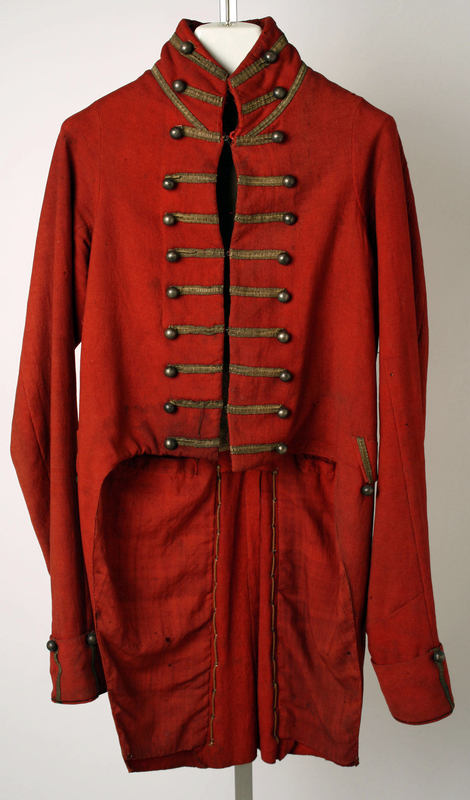
Wear a modern tailcoat. Actually, wear the most old-fashioned tailcoat you can find (if you invest in a tailcoat that is good for the 1860s now, you can wear it to this AND to the Returning Heroes Ball next month!). I am not going to give suggestions for modifications, because there are not really any easy fixes. The front should end near the waist, with an inch or two of waistcoat showing below. It should either be scooped (good for early regency), or straight across with an angle to the straight sides of the tails (good for late regency). The easiest way to identify a really good regency tailcoat is the lack of a seam at the waist, where the tails join. This became very much the norm for the mid-19th century, but was totally unheard of at this point. If your tailcoat already has this seam, there is no way to get rid of it, so just smile and ignore it. Really, in terms of getting the silhouette right, it is not so critical. In terms of colors, there is also more variation here than later in the century when men take up the all-black all-the-time approach to dressing. Still, black is very serviceable, so that is what I would personally go for. I should also warn you that most regency tailcoats were double breasted, while most modern tailcoats are meant to look single breasted AND are meant to hang open. As I said before, to be perfect you must learn to sew, but you can look good enough without.


On the bright side, I can promise you that this is no reason to stay away from the Commonwealth Vintage Dancers' ball this Saturday! I look forward to seeing you in whatever formal or semi-formal outfit you have lying about. But let me stop skirting the issue and take a stab at it.
To be dressed, you are going to need pants, a shirt, a vest, and a jacket. Ooh, and a neckcloth. Sir Percy Blakeney would never forgive me if I forgot that. If you are out and about, you would also need a hat and perhaps an overcoat - since they won't be missed in the ballroom, I won't even go there right now. To really get it right, I think you have to start from scratch and learn to sew. So the long term goal is to learn to sew, look really spiffy, and then pick up girls with both your fabulous wardrobe AND your fabulous sewing skills. It worked for my father. It is also working for the guy in these pictures. In the short term, let's see what limited-sewing modifications I can come up with for getting the right look.
Pants (and a little about boots and shoes)This is a tough one. Your should probably, especially for a ball, be wearing breeches. Until your local Breeches-R-Us opens up, or men's fashions change in a rather unexpected manner, you won't just find these. But it is possible to fake them with limited sewing skills, by modifying a modern pair of pants to make them short, and adding a piece to cover the modern fly with a fake "broad fall."
Take a pair of pants, and chop off the bottom of the legs, a few inches below the knees. From those removed pieces, make two rectangles that measure (2x a good depth for the band + an inch for seam allowance = probably about 4 inches) by (the circumference of your leg where the pants will end +1 in for seam allowance + more if you want to overlap and add a button). Make these into cuffs (sew them into a circle, fold in the seam allowance along both edges, fold in half with the seam allowances on the inside, and sandwich the cut end of the pants into that). Also from the leftover pant legs, cut out a rectangle of fabric. Finish the edges (fold in so there are no raw edges), and sew this onto the front of the pants to cover the fly.
There are other options. Long pants were beginning to show up in the regency period. They would not have been appropriate for a ballroom, but I won't tell if you won't. Some of these were sort of full, similar to modern trousers (though the modern fly design is really too modern). A lot of them had really skinny legs, more like the skin-tight buckskin breeches look. If you have them, wear them. If you have a pair of stunning boots, especially Hessian boots (with the cool dip in the front and a cute tassel!), all the better. But as hard as it is to fake pants, I bet it is harder to fake boots - plus they are not so good for dancing. For dancing, leather slippers were fashionable, so modern men's ballet flats or jazz oxfords would be cool, or just wear your favorite dress-shoes for dancing.


ShirtFind a white shirt with a collar. Done. Really, the ideal regency shirt would be along the lines of a poet's shirt - voluminous sleeves, very plain but full. If you are interested in sewing, this is a good and easy project to get started on. If you are not good at sewing, this will be one of the least visible parts of your outfit, mostly covered by other clothing. Put on the shirt, flip up the collar, and tie a neckcloth around it.

NeckclothA spiffy cravat, or intentionally understated neckcloth if you prefer, will be indispensable. Luckily, it is just a big rectangle of white cloth (preferably linen, but work with what you have)! How do you tie it? Again, this is not so much my area of expertise. Check out this collection of descriptions here (Neckclothitania), or look at portraits and fiddle with things until you get it to look right. Just remember to pop the collar first.


VestI suppose I should call it a waistcoat, but I am a mid-19th century girl at heart, so I forget these things. The most critical and noticeable difference between a regency waistcoat and a modern tailcoat is the bottom edge. It should be totally flat across. This should be an easy thing to fix, by flipping the points on a modern vest up and pinning them or sewing them to the inside. The nice thing is that these early century waistcoats can be much more spiffy and fantastically colored than for their later in the century cousins, so enjoy your freedom.


JacketWear a modern tailcoat. Actually, wear the most old-fashioned tailcoat you can find (if you invest in a tailcoat that is good for the 1860s now, you can wear it to this AND to the Returning Heroes Ball next month!). I am not going to give suggestions for modifications, because there are not really any easy fixes. The front should end near the waist, with an inch or two of waistcoat showing below. It should either be scooped (good for early regency), or straight across with an angle to the straight sides of the tails (good for late regency). The easiest way to identify a really good regency tailcoat is the lack of a seam at the waist, where the tails join. This became very much the norm for the mid-19th century, but was totally unheard of at this point. If your tailcoat already has this seam, there is no way to get rid of it, so just smile and ignore it. Really, in terms of getting the silhouette right, it is not so critical. In terms of colors, there is also more variation here than later in the century when men take up the all-black all-the-time approach to dressing. Still, black is very serviceable, so that is what I would personally go for. I should also warn you that most regency tailcoats were double breasted, while most modern tailcoats are meant to look single breasted AND are meant to hang open. As I said before, to be perfect you must learn to sew, but you can look good enough without.


Monday, February 7, 2011
Regency Surface Features
If you are just throwing an outfit together from your closet (hopefully for the Sense and Sensibility Bicentennial Ball this Saturday!), use my previous post and ignore this one. I promise that getting the shape right is all that really matters. On the other hand, if you are interested in more of the finer points of regency dresses (and seeing some really drool-worthy examples), today is for you. You might be able to use some of this information to improve a dress, like trims or overlays, or it might help you keep an open mind (for example, to colors) when you are in a thrift store.
Colors
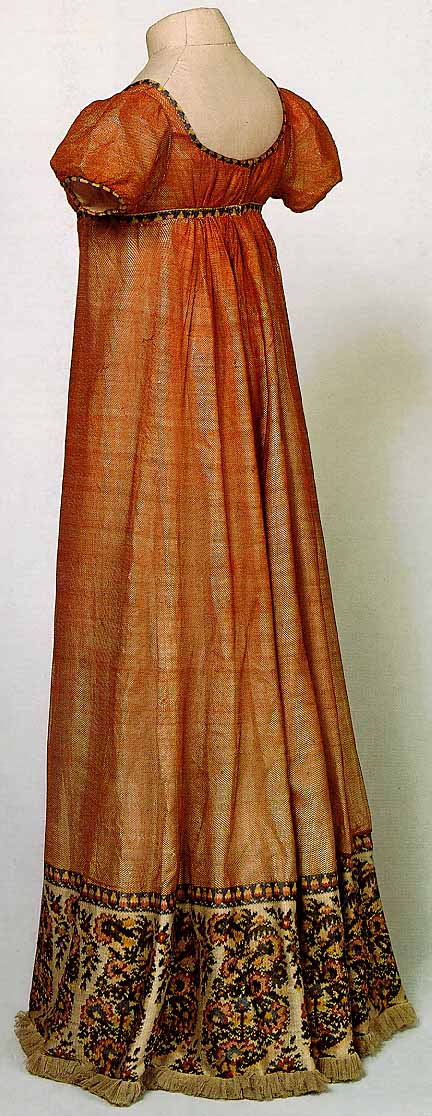
Not all Regency dresses were white. A lot of them were, and they are really gorgeous. You don't need to avoid white, but you also should not feel stuck to it. In fact, a plain white dress is at best rare. That sort of gauzy dress you are imagining right now should probably have a subtle pattern woven into the fabric, or maybe a healthy dose of embroidery.
Now it is true that not all colors existed yet, or could be made into dyes for fabrics. We are talking about a period before some of the most exciting advances in dyeing technology. But don't be afraid of color. If you followed my moment of insecurity a few weeks ago, you are more than aware that yellow is a great Regency color. There really are others, too.


Check out this interesting article I found about funny color names in this period. Don't you feel more special now that you can tell people that you are wearing a coquelicot dress? And indeed, don't you feel superior just for knowing what puce looks like?
Embroidery
There is embroidery all over the place. This is probably my favorite example, though.
Overlays
Sheer gauzy fabrics were all the rage. This includes near-indecent sheer white dresses, but also cool overlays for your dresses! Check it out.


Metallic Trims
I've been seeing a lot of dresses with metallic elements - either the fabric itself, or some embroidery, or some really smashing trim!


Military Styling
Very popular, especially in a cute spencer or pelisse.
Classical Influence
I have little to say on this, but just look around. The gauzy white draping? The columnar silhouette? Regency is all about the classical influences.


Mind Boggling Embellishments - A Case Study
I am totally in love with Princess Charlotte. I've already shown you a picture of her jumper dress (see Faking Regency 101 in the sleeves section). This is her bellflower dress. I don't even know what to say about it, it is just so lovely. Thanks to Vic of the Jane Austen's World blog for making these great pictures available - go here to read a whole post about this dress.


Colors
Not all Regency dresses were white. A lot of them were, and they are really gorgeous. You don't need to avoid white, but you also should not feel stuck to it. In fact, a plain white dress is at best rare. That sort of gauzy dress you are imagining right now should probably have a subtle pattern woven into the fabric, or maybe a healthy dose of embroidery.
Now it is true that not all colors existed yet, or could be made into dyes for fabrics. We are talking about a period before some of the most exciting advances in dyeing technology. But don't be afraid of color. If you followed my moment of insecurity a few weeks ago, you are more than aware that yellow is a great Regency color. There really are others, too.


Check out this interesting article I found about funny color names in this period. Don't you feel more special now that you can tell people that you are wearing a coquelicot dress? And indeed, don't you feel superior just for knowing what puce looks like?Embroidery
There is embroidery all over the place. This is probably my favorite example, though.
OverlaysSheer gauzy fabrics were all the rage. This includes near-indecent sheer white dresses, but also cool overlays for your dresses! Check it out.


Metallic TrimsI've been seeing a lot of dresses with metallic elements - either the fabric itself, or some embroidery, or some really smashing trim!


Military StylingVery popular, especially in a cute spencer or pelisse.

Classical InfluenceI have little to say on this, but just look around. The gauzy white draping? The columnar silhouette? Regency is all about the classical influences.


Mind Boggling Embellishments - A Case StudyI am totally in love with Princess Charlotte. I've already shown you a picture of her jumper dress (see Faking Regency 101 in the sleeves section). This is her bellflower dress. I don't even know what to say about it, it is just so lovely. Thanks to Vic of the Jane Austen's World blog for making these great pictures available - go here to read a whole post about this dress.


Labels:
Extra Informative,
Guide,
Historical Clothing,
How-to,
Recreating History,
Regency
Subscribe to:
Posts (Atom)