Monday, February 7, 2011

Regency Surface Features

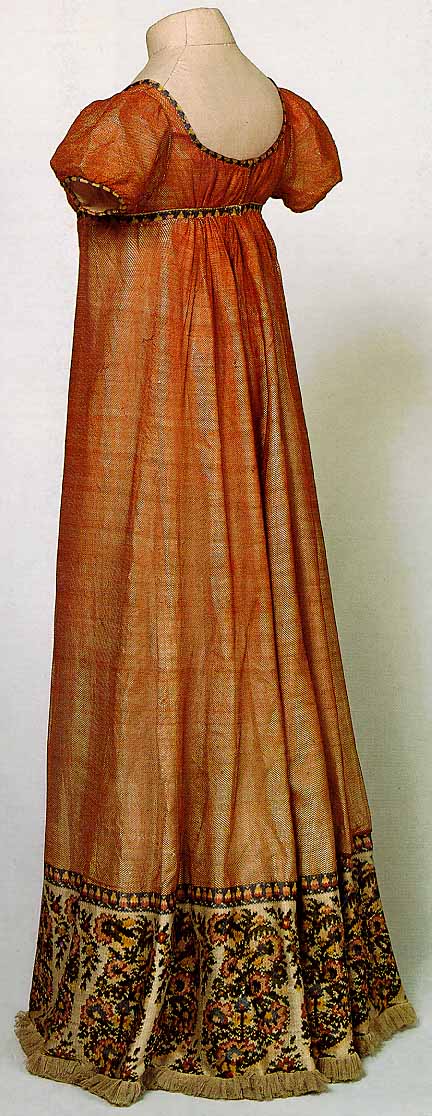
If you are just throwing an outfit together from your closet (hopefully for the Sense and Sensibility Bicentennial Ball this Saturday!), use my previous post and ignore this one. I promise that getting the shape right is all that really matters. On the other hand, if you are interested in more of the finer points of regency dresses (and seeing some really drool-worthy examples), today is for you. You might be able to use some of this information to improve a dress, like trims or overlays, or it might help you keep an open mind (for example, to colors) when you are in a thrift store.

Colors
Not all Regency dresses were white. A lot of them were, and they are really gorgeous. You don't need to avoid white, but you also should not feel stuck to it. In fact, a plain white dress is at best rare. That sort of gauzy dress you are imagining right now should probably have a subtle pattern woven into the fabric, or maybe a healthy dose of embroidery.
Now it is true that not all colors existed yet, or could be made into dyes for fabrics. We are talking about a period before some of the most exciting advances in dyeing technology. But don't be afraid of color. If you followed my moment of insecurity a few weeks ago, you are more than aware that yellow is a great Regency color. There really are others, too.
Check out this interesting article I found about funny color names in this period. Don't you feel more special now that you can tell people that you are wearing a coquelicot dress? And indeed, don't you feel superior just for knowing what puce looks like?

Embroidery
There is embroidery all over the place. This is probably my favorite example, though.
Overlays
Sheer gauzy fabrics were all the rage. This includes near-indecent sheer white dresses, but also cool overlays for your dresses! Check it out.
Metallic Trims
I've been seeing a lot of dresses with metallic elements - either the fabric itself, or some embroidery, or some really smashing trim!
Military Styling
Very popular, especially in a cute spencer or pelisse.Classical Influence
I have little to say on this, but just look around. The gauzy white draping? The columnar silhouette? Regency is all about the classical influences.
Mind Boggling Embellishments - A Case Study
I am totally in love with Princess Charlotte. I've already shown you a picture of her jumper dress (see Faking Regency 101 in the sleeves section). This is her bellflower dress. I don't even know what to say about it, it is just so lovely. Thanks to Vic of the Jane Austen's World blog for making these great pictures available - go here to read a whole post about this dress.

Friday, February 4, 2011

Why Mr. Darcy, I had NO IDEA!

No. This is not precisely how the dancing will go at the Sense and Sensibility Ball. But it will still be fun!

Thursday, February 3, 2011

How to Fake Regency - A Guide to the Silhouette

Right now I am suffering from Regency fever. I am so excited about the upcoming ball, and I can't stop looking at dresses and period sources. I've also realized that not everyone has the resources to get a nice reproduction dress ready at the drop of a hat. Now, lucky for those people the Commonwealth Vintage Dancers rarely require period costume for attendance to their balls. So pop on some formal outfit you have lying around and come join the dancing! Don't let the lack of the perfect costume intimidate you out of showing up - I'd be so much happier to see a lot of people having fun and learning than a few people perfectly dressed.

On the other hand, it always feels more special to be able to dress up and feel like a princess. And in a particularly nice twist of fate, the Regency silhouette is not that difficult to achieve. Once you have the silhouette right, you will have captured the feeling of a Regency outfit, even if the specifics are off. So here is a guide to faking a Regency outfit, stressing the most important elements for getting the right silhouette.

The High Waist
The most noticeable feature of Regency dresses is their artificially high waistlines (often referred to as an empire waist). If you can get this right, you have made the first step towards a good Regency silhouette. Luckily, this is not a dead fashion. I know that empire waists have been popular within the past few years, which means ideal opportunities to find something appropriate in the used clothing stores, or in your very own closet. Go look!

If you have a dress without a defined waist (don't try this if there is a defined waist lower down, though), you can add this definition by tying a plain ribbon around your ribcage. This is a very period look, and is especially spiffy if you add tassels to the ends of your ribbon. Ooh!
The Long Skirt
There is no way to avoid this. If you have an absolutely perfect Regency dress that ends at the knees, you are going to look silly. Well, actually, you will look really cute - but you will not look Regency. On the bright side, this too can be fixed! There were points in time where the "tunic" look was very fashionable indeed, so you can put together a stunning early Regency ensemble by layering your too-short high-waisted dress over a long skirt in a matching or coordinating color. If you have a really good color match (like white and white), or a nice sash to make the change less jarring, you might even layer the long skirt over the too-short dress and make it look like one long dress.
A lot of formal evening dresses in the period had trains. That is lovely, but you are unlikely to find them on modern garments. In fact, you should just count this as a blessing, as you won't have to figure out how to dance in a train (hint - it involves pinning up, removing, or otherwise securing it... too much work). So you should know they exist, but instead of worrying about replicating them, you should come dancing with me!
Sleeves of Some Description
So at this point you have a high-waisted dress with a long skirt. Unfortunately, a lot of modern dresses that will get you to this point are strapless. I am going to strongly urge you to do something about this. I have trouble thinking of anything less 19th century than a strapless dress. But never fear! There are a number of things you can do about this. If you are particularly crafty, you can always add sleeves, or at least straps. Jumpers are legitimate for Regency, though they get worn over a blouse. Short sleeves, which might be quite puffy or rather plain, are what I most commonly see, but long sleeves are also alright. No sleeves would be unacceptable, though.The good news if you are not crafty is that little jackets called "spencers" were all the rage in the Regency. I have frequently seen extra-short-waisted jackets in modern stores that would serve this purpose well. You could also wear a short bolero jacket, another style I see all the time. You might even get away with a shawl or similar covering, but if you are relying on it to cover otherwise bare shoulders for an entire evening, you are probably better off with the jacket. If you have no luck locating a short jacket, go for a long robe instead, and tie a ribbon around your ribcage and over the robe. This should provide you with sleeves, a high waist, and a tunic-style dress all at once.
An Appropriate Neckline
I add this because it matters, but there is not much you can easily do to modify this if it is wrong, so try not to worry as much about it. It is certainly a much less important structural element for building the Regency feeling than the previous three things. The good news is that the neckline styles varied over the Regency period, so you can get away with more than you might have expected. The most common style I see is the scooped neck. It is usually somewhat low-cut, and can be very low-cut, and had a nice round shape. There were also a lot of dresses with very wide square necklines. I don't even think of these as "square" necklines so much as "straight," since they look like they stretch flat across from sleeve to sleeve. Hopefully the images will help where my descriptions are failing. There were also v-necked dresses, with plunging necklines.

Wednesday, February 2, 2011

Event Announcment - Dancing with the Dashwoods

All the balls that the Commonwealth Vintage Dancers run are fun and beautiful, but this one is going to be particularly special. First of all, I will be teaching, so I am particularly excited. Second of all, we are working with lovely musicians in a perfect hall (the Salem Old Town Hall was built in 1816!). Also, it is still kind of early, and we already have a lot of registrations. So if you haven't registered, I suggest you get right to it (just in case we run out of space - anyone who went to Fezziwig's ball knows it is possible to hit capacity on this hall). Here are the details, and as always go to vintagedancers.org for more information, or write to query@vintagedancers.org for questions.

You are Cordially Invited
to the

Sense and Sensibility
Bicentennial Ball

Saturday, February 12, 2011
Salem’s Old Town Hall

32 Derby Square, Salem, MA

Workshop 4 to 6 pm
Ball 8 to 11 pm

Live Music by
Jaqueline Schwab and Eden MacAdam-Somer

ADMISSION
General $25
Students (with id) $15
($5 surcharge after Friday February 11)
Please inquire for group rates

Tuesday, February 1, 2011

The Original Gingerbread Trilobites

Check out this cool thing. First of all, this looks like a 5th CD of papers about trilobites. That means there are more papers about trilobites than I ever knew about. Cool! But more importantly, on CD 5 there is an article about really old gingerbread molds in the shape of trilobites! I'm quoting here from that website (DIRT - the Denman Institute for Research on Trilobites - I am so glad this exists, so go check it out):

Trilobites as Gingerbread Molds

Irena Jancarikova & Ivo Chlupac
Charles University, Prague

The Museum of Bohemian Karst in the town of Beroun southwest of Prague (Barrandian area, Czech Republic) possesses in its ethnographical collections two gingerbread molds in the form of trilobites. The first mold (Figure 1) is made of nut wood, measuring 22 by 11 cm. It represents a precisely cut exoskeleton of the Lower Devonian trilobite Odontochile rugosa Hawle and Corda, 1847. The carved image corresponds closely to actual specimens -- only the pygidial border is lacking. The second mold (Figure 2) is made of lime wood, measuring 16.5 by 8.5 cm. It was probably also based on an exoskeleton of Odontochile, but the model appears to have been a counterfeit specimen made by assembling a retouched cephalon and an incomplete thorax and pygidium. Such counterfeits were commonly produced by quarrymen in the Beroun district during the last decade of the 19th and the beginning of the 20th century and sold to gullible private collectors who were largely interested in complete specimens.

These two wooden trilobite gingerbread molds are true rarities. They exemplify the deep-rooted tradition of trilobite collecting in the Barrandian area -- a tradition here seen to extend into everyday objects in the life of the local people.

Monday, January 31, 2011

Gingerbread Trilobites

If you are not aware, there is this amazingly cool Steampunk online comic called Girl Genius (actually, I believe they prefer the term "gaslamp fantasy," but since I consider this the epitome of what Steampunk ought to be, I won't shy away from using the phrase). First of all, go read it. I'm a big fan.

Now on to the real point - one of my very favorite things about our Technocrats' Ball was that I got to make gingerbread trilobites (and also sugar-cookie gears - see the picture above). There are a couple of really throw away comments made in the Girl Genius comic to "gingerbread trilobites" which are famously made in a particular city (where the ruling family's symbol is a trilobite). I can't say that my interpretation is necessarily what the makers of Girl Genius had in mind, but I am particularly proud of them and wanted to share (mine were definitely the cookie type of gingerbread, based on a recipe for rolled out and cut gingerbread men, not the more cake-like style of gingerbread). I will now share my super-secret (yet painfully obvious and devastatingly easy) technique, so you may make your very own gingerbread trilobites at home!
Make some gingerbread dough. I used a (very slightly modified) recipe for "Gingies" from a 1950s Betty Crocker Cookbook. If you want to make exactly my cookies, then:

1/3 c. shortening (I use butter or margarine, but only because I am too lazy to measure out gooey shortening, bleh!)
1 c. brown sugar
1 ½ c. dark molasses
½ c cold water
6 c. flour
1 tsp. salt
1 tsp. allspice
1 tsp. ginger (I use 1 tbsp. ginger)
1 tsp. cinnamon
2 tsp. baking soda dissolved in 3 tbsp cold water

Bake 15-18 min in 350 oven - bur first you have to shape them into cute little trilobites!

First, you need to make a number of oval disks. Take a small scoop of gingerbread dough, about the size of a walnut, into your hands. Roll it into a sphere, and from that into a very short log. Squash the log down onto your cookie sheet, and you should have the necessary oval.
Now, use the blunt edge of a knife to score a line across the oval, about a quarter of the way from one of the ends.On the large side of unmarked cookie, make two lines almost purpendicular to that one, but slightly angled towards each other (\/). Now make a number of lines parallel to the original mark, all down the body of your trilobite.Last of all, add two non-pareils for eyes (I used silver or gold, and they looked smashing). You may instead make two two holes with a chopstick, or even skip the eyes altogether, for more rustic-looking trilobites. Then bake them!
Also, if you were interested, here is my documentation:
Reference to how good the gingerbread of Mechanicsburg is

Reference to gingerbread trilobites

Steampunk Outfit from the Technocrats' Ball

I did a very bad job of taking pictures at the Technocrats' Ball, which was totally lovely and went really well - it was great seeing so many people in their Steampunk best! Luckily, last week I wore the very same outfit (shhhh! don't tell) to a Steampunk meet-up in Waltham at the Charles River Museum of Industry. You'll have to settle for some pictures of that. The bodice is based on a Truly Victorian pattern, slightly modified. The skirt was totally made up, but worked out really well. The overskirt was a recycled costume piece (so there are two shades of purple, but only two - not clear in these pictures). This was just supposed to be a quick and dirty costumey Steampunk pattern test, so it is made in horrid (inexpensive!) polyester fabric that photographs badly, but which is actually really cool for Steampunk purposes. Yay!

Friday, January 28, 2011

Steampunk 102: Who is Steampunk?

Yesterday's post gave you a crash course in some common motifs of steampunk fashion. Today's lesson is an introduction to some of the overarching Steampunk styles.

The three main elements of Steampunk style are
1) Science
2) Adventure
3) History

Any given outfit is likely to incorporate more than one of these, but also likely to favor one over the others. For the sake of this lesson, we are going to say that a historical influence (almost always the 19th century, which is what makes the most sense in terms of the actual course of steam technology) applies to all outfits to different degrees, but is not critical in determining the 'personality.' This leaves us with two main categories, with styles that favor either science or adventure (though usually not to the exclusion of the other). Any of these can be interpreted into a male or female costume, so don't mind the example pictures. Also, these should be inspiration and starting points - it is not an exhaustive list, so don't feel limited!

What follows is a random sampling of some of the most commonly seen styles in Steampunk fashion. Which are your favorites? Are you a slave to science, or a daring adventurer? Leave a comment!

SCIENCE

The Engineer
This person might tinker with clock-like contraptions, or design monstrous huge engines, or make any sort of mechanical wonder, probably involving steam technology.
Suggested accessories: engine grease, fitted clothes (to keep out of moving parts), goggles!, heavy gloves, heavy aprons, lots of tools

The Mad ScientistJust as much of a scientist as the engineer, but more interested in studying things than in building them.
Suggested accessories: lab coats, lab equipment, a notebook for keeping track of observations, a good maniacal laugh

The Aviator
This person could pilot an airship, or might instead have some kind of personal flying machine. They sure know the ropes - and the gears, and the engines, and the helium sacks, and the pistons, and... you get the idea.
Suggested accessories: aviator goggles, aviator caps, a dashing aviator's scarf, tailored garments for dangling off ladders and rigging while in the air

The Clockwork Person
This person was made (probably by some engineer!), and not born. Imagine steam-powered automatons so complex that they are difficult to distinguish from their biological counterparts.
Suggested accessories: gears, a maker's mark, rivets that look structural, a portion of clothing or skin (use makeup!) that pulls away or is missing to expose complex inner workings with machinery and gears

The Enthusiast
There is no mistaking that this person is a lady or gentleman. But they also like science. Whether this is a well-bred person who dabbles in scientific fields, or wealthy patron of science who funds the expeditions and research of more serious scientists, they should be well dressed and ready to do what they can - FOR SCIENCE!
Suggested accessories: a stunning 19th century outfit plus a pair of goggles, amazing machines you have made or bought

ADVENTURE

The Airship Pirate
This is a big one. Pirates are bad-ass and adventurous. Airships and zeppelines are astounding feats of engineering with a historical precedent. The idea of a pirate crew aboard an air-travel vehicle is a staple of Steampunk literature. Likewise, the look of an air pirate is a staple in Steampunk fashion.
Suggested accessories: eye patches or steampunk monocles, loose pirate shirts, baggy bloomer-like pants, weapons

The Military Man (or Woman)
Military elements show up in a lot of Steampunk clothing. Sometimes these are complete fantasy, and sometimes these are borrowed from various 19th century armies, but all they time they are stylish and neat.
Suggested accessories: epaulets, pauldrons, armor, piping and military-style trim, shiny buttons, clean-cut jackets, military hats, medals or patches, military-issue weapons

The Explorer
Somebody get this man a pith helmet! The explorer goes adventuring to far off lands, and might incorporate elements of the local dress into his or her wardrobe. On the other hand, I have no problem with the Anglo-centric model of Steampunk, so the explorer in my mind wears khaki and linen, taking his or her cues from 19th century archaeologists and big game hunters.
Suggested accessories: pith helmets, khaki vests or jackets, linen suits, packs and bags, compasses or navigational tools

The Street Urchin
A lot of people get fixated on the "punk" in Steampunk. The word itself is modeled after other terms, like "Cyberpunk," for sub-genres that were rather more punk-y. I see no reason, personally, that Steampunk clothes should be tattered or streaked with soot, UNLESS you are some kind of Steampunk street urchin or chimney sweep! So that is how I think of these people, though I think some of them may just be confused about the meaning of Steampunk.
Suggested accessories: soot, torn or ratty clothing, caps set at a rakish angle, a lower-class British accent

The Spy or Saloon Girl
Let's face it - a lot of women's Steampunk outfits follow the exposed corset formula. I have seen a lot of "Steampunk Saloon Girls," and also a lot of "Generic Steampunk Woman Who Runs Around In Her Underwear," but I didn't think that last title was really up to snuff. So I'm going to call them spies, because for all I know that is the truth, and the exposed undergarments are a ploy to distract us from their adventurous and dangerous spy plans. But really, they are women in underwear. One way or another, that certainly goes in the "adventure" category.
Suggested accessories: spy gadgets, short skirts, really cute underwear including corsets, hoops, bustles, bloomers, chemises, garters, and more